(J)
Ban (Shigeru) (1957)
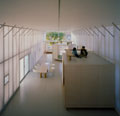
• Naked House réalisé, 2000
| Shigeru Ban was born in Tokyo in 1957, and graduated from the Cooper Union School in 1984. He worked as Arata Isozaki's assistant for a year and then set up his own agency in Tokyo in 1985. In tandem with his architectural practice, he has been teaching since 1993. He is currently teaching at Columbia University where, over and above theoretical aspects, he is attempting to develop a line of thinking about the reality of praxis. In addition to his famous cardboard constructions, most of his works are based on new constructional techniques and methods. Yet we often find in his work rules which comply with Japanese tradition: the walls are rarely load-bearing, and sometimes they don't even exist at all. ( Wall-less House, 1997). The universal plan, which is a single space with no divisions in it, is still one of his major preoccupations. For Shigeru Ban, agreeing to design a private residence always represents a challenge, taking into account the wishes and requirements of the customer without giving up his own persuasions. Naked House (case study 10) illustrates this position which he adopts with regard to the client. The brief was to give everyone the freedom of carrying on private activities in a house where the spirit of a united family predominates. Shigeru Ban met this brief by designing a large free space containing four moveable cubes, which can be moved about to meet different uses. The walls are translucent and made of corrugated fibreglass on the outside, lined with an inner nylon wall, and given rigidity by a wooden structure. Between the two, insulation consisting of transparent plastic bags, filled with polyethylene fibre, distills the light inside the house. It is a flexible house, just as Shigeru Ban intended, suitable for family life, just as the client wished. |
(J)
|
| Shigeru
Ban Architects Ban (Shigeru) (1957) |
|
• Naked House réalisé, 2000 |