(Base for Architecture and Research)
Germany
Antje Buchholz (1967), Michael von Matuschka (1964), Jack Burnett-Stuart (1963), Jürgen Patzak-Poor (1959)
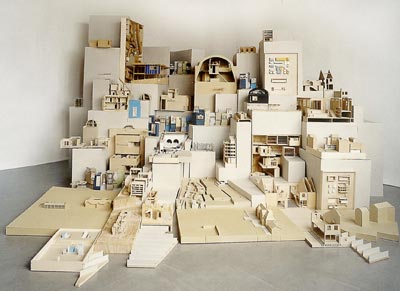
The Berlin-based BAR group was founded in 1992. Four interdependent areas of activity define the group’s practice: the concept of economy, the foundation stone of every project; the use of models, which makes it possible to deal with underlying city themes; case studies, as an exploratory method for investigating urban diversity; and experimental construction, the space where the architect’s expertise is redefined. This framework has been used by BAR, in various places in Europe, to initiate a process of interaction between site, architect, and user. Based on documentation of found situations, handled with an almost ethnographic level of description, the group draws inspiration from the everyday, with the aim of using this analysis of the commonplace as a source for developing a line of prototypes, encompassing shifts in scale from furniture to urban strategies. Such projects range from Das Durchgangsbad (1993), a passage bathroom for one-room apartments, to strategies for urban infill in towns in Brandenburg (1996). BAR’s activity has focused, more recently, on housing (m3-house, since 2003; and Schwedter Strasse 26, 1999-2002) and on urban research and development projects (City in Conflict, 2003-2004; Building Initiative, 2004- 2005). In addition, members of BAR have taught at SCI-ARC in Los Angeles, at the Freie Universität in Berlin, as part of an urban anthropology seminar, and at the University of Ulster, Belfast.